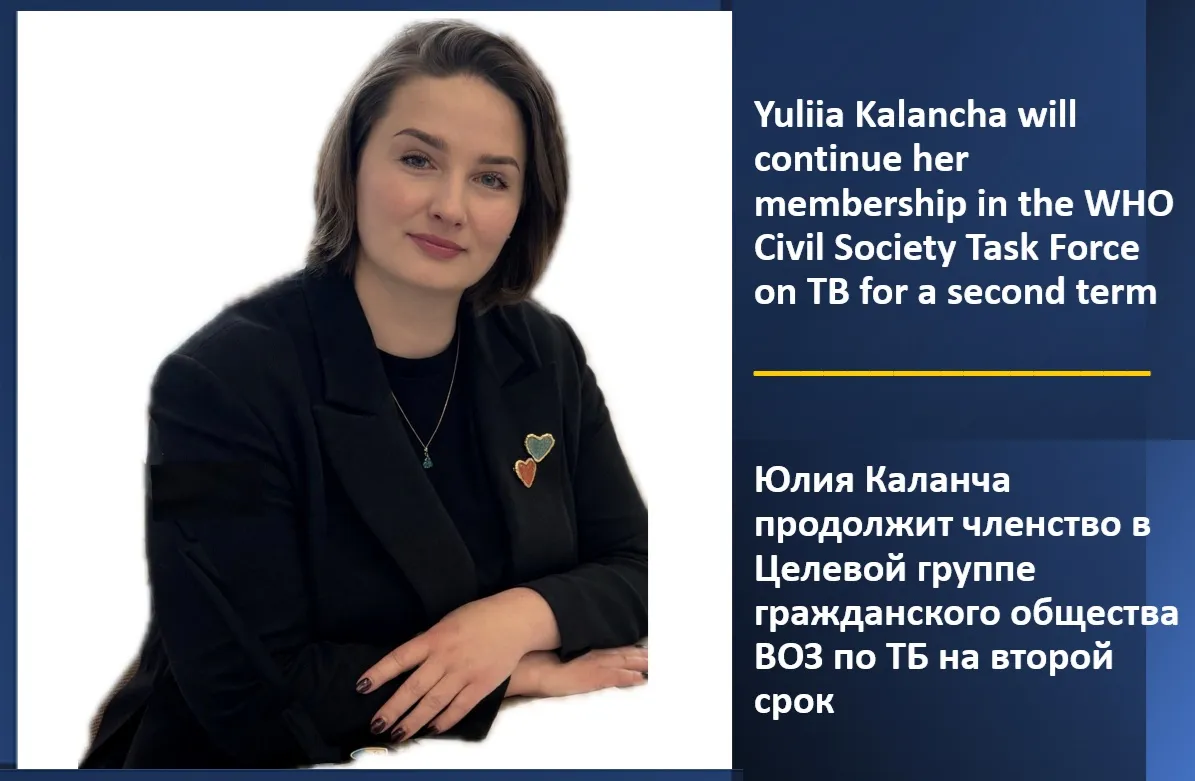
Yuliia Kalancha, Executive Director of TBEC, will continue serving for a second two-year term as a member of the WHO Civil Society Task Force on TB (CSTF-TB).
During 2026–2027, Yuliia will continue to strengthen the voices of communities and civil society organizations from the WHO European Region within CSTF-TB and contribute her expertise to enhancing the meaningful engagement of civil society in collaboration with the World Health Organization and in efforts to end TB.
Despite unprecedented financial and institutional changes in 2025, CSTF-TB continued to advance meaningful community and civil society engagement at all levels of the TB response. The Task Force expanded its role in the development of WHO TB policies and guidelines, strengthened annual country progress reviews using WHO indicators, contributed to generating evidence to support the investment case for community engagement, and developed tools to help countries implement more equitable, people-centered TB responses. CSTF-TB members participated in key WHO guideline development groups, policy and technical dialogues, and global reporting processes, ensuring that affected communities were not only heard but also actively shaped decisions. They also advocated for sustained prioritization and financing of meaningful community engagement despite austerity measures.
Among the key functions of CSTF-TB are:
1. Bringing the voices and priorities of communities and civil society from the grassroots to the
national, regional and global levels, including in the development of WHO norms and
standards;
2. Advising on advancing the implementation of the WHO End TB Strategy and related
guidance and policies and contribute to the attainment of the United Nations Sustainable
Development Goals, focusing on promotion of the WHO Guidance on engagement of
communities and civil society to end tuberculosis, fostering multisectoral action, and
translating the political declaration of the 2023 UN High-Level Meeting on TB into action;
3. Advising on strengthening collaboration between civil society and communities affected by
TB and WHO, national tuberculosis programmes (NTPs) and stakeholders in efforts to end
TB;
4. Providing direction on initiatives to build the capacity of communities and civil society to
enhance networking, facilitate sharing of information, knowledge, good practices and
innovation, and promote dialogue and consultation on the implementation of WHO’s TB
policies and norms through meaningful community engagement;
5. Advising WHO on advocacy initiatives to increase domestic and donor funding for the TB
response at all levels;
6. Providing critical evaluation of community and civil society engagement to end TB at the
various level (national, regional and global).
We congratulate Yuliia and wish all CSTF-TB members every success as they continue their important mission.